Materials and chemicals
Making clothes requires raw materials, water, energy and chemicals. From growing fibres to dyeing fabrics and finishing garments, every step has an impact on the environment. Here you can read about the materials we use, the requirements we set for our suppliers and how we monitor the use of chemicals.
Materials
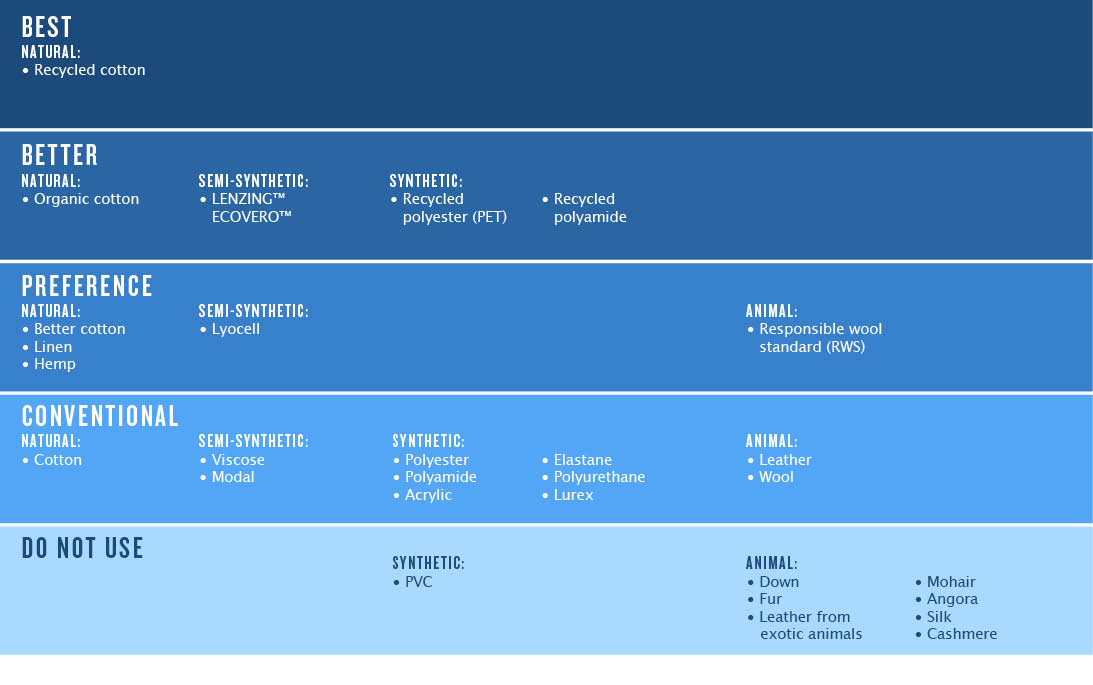
To support our sourcing decisions, we use the Modint Fiber Matrix (MFM). It classifies fibres based on various environmental criteria and helps us prioritise our material choices. We use some materials that are not included in the MFM and have classified these as "conventional" in the list. We have also added the materials we explicitly choose not to use. We continually update the list in line with industry standards and developments.
In 2025, 78% of the materials we used fell within the ‘preferred’, ‘better’ or ‘best’ categories of the Modint Fiber Matrix.
Organic cotton
- Organic cotton is grown according to organic farming standards, which restrict the use of pesticides and fertilisers.
*For more information on the environmental impact of cotton farming, click here.
Better Cotton Initiative
America Today has been a proud member of Better Cotton since June 2018. Better Cotton trains farmers to use water efficiently, care for soil health and the natural environment, reduce the use of harmful chemicals and apply the principles of decent work. Better Cotton has calculated that our contribution to the Better Cotton programme in 2025 helped achieve an estimated:
- 7 million litres of water saved;
- 23 kg of pesticides avoided.
Better Cotton is sourced through a mass balance system. This means that America Today sources cotton through Better Cotton. Farmers produce this cotton and sell it to traders and yarn manufacturers. These cotton fibres are then mixed with other cotton. This means that Better Cotton cannot be physically traced to finished products, but Better Cotton farmers benefit from demand for Better Cotton in volumes equivalent to those we source. Read stories from the field here.
In 2025, 100% of our cotton was sustainably sourced. Of this, 76% came from the Better Cotton Initiative, 19% was organic and 5% was recycled.
Recycled polyester
- Recycled polyester is made from waste materials such as plastic bottles, plastic packaging or polyester textiles.
- By using recycled polyester in our clothing, existing materials are reprocessed into fibres.
*For more information on polyester production and its environmental impact, click here.
Recycled nylon/polyamide
- • Recycled polyamide is made from waste from other polyamide products, such as old fishing nets and industrial waste.
Please note: recycled nylon and recycled polyamide are the same material.
Recycled acrylic
- • Recycled acrylic is made from acrylic waste. By using recycled acrylic, we give acrylic waste a second life.
Recycled cotton
- Recycled cotton is made from cotton production waste or previously used cotton textiles. By using recycled cotton, we give existing cotton fibres a second life.
*For more information on the environmental impact of cotton farming, click here.
LENZING™ ECOVERO™
- LENZING™ ECOVERO™ branded viscose fibre
- Made from wood pulp from certified and controlled sources.
- The production of LENZING™ ECOVERO™ branded viscose fibres generates up to 50% lower emissions and water impact compared with conventional viscose. This comparison relates to fibre production, not the entire garment, and is based on LCA data available through Higg MSI version 3.9.1, dated December 2024.
All our LENZING™ ECOVERO™ items have a certificate from LENZING™. You can find more information about LENZING™ ECOVERO™ here.
Livaeco™ viscose
- Livaeco™ viscose fibres by Birla Cellulose. Livaeco™ viscose fibres are sourced from FSC-certified forests.
- Producing these fibres generates up to 55% fewer GHG emissions and uses up to 60% less water compared with conventional viscose, according to the Sustainable Apparel Coalition’s Higg Materials Sustainability Index (MSI) tool.
Livaeco™ viscose fibres are traceable throughout the supply chain using blockchain technology. You can find more information about Livaeco™ by Birla Cellulose here.
Linen
- Linen is made from the fibres of the flax plant.
Animal-derived materials
We care about animal welfare. We have banned the use of fur, exotic skins, silk, mohair, angora and cashmere in our collections. We are also included on Bont voor Dieren’s Fur-Free List and are listed as Angora Free and Cashmere Free by the People for the Ethical Treatment of Animals (PETA) Foundation.
We use a small percentage of wool, down and leather in our products (0.3% leather and 0.5% wool in 2025), and we are aware of the potential animal welfare risks associated with these materials, such as mulesing in wool production. To support a future without mulesing, we have signed FOUR PAWS’ ‘Brand Letter of Intent’. We do not use conventional down. In some of our jackets, we use recycled down, a long-lasting natural material that we are happy to give a second life. We are not certified to the Responsible Wool Standard or standards for recycled materials ourselves, but our direct suppliers and their supply chains for these materials are. We request these certificates so that we can trace the materials.
Our animal welfare policy sets requirements for the treatment, transport and slaughter of animals, based on the Five Domains Model of animal welfare. We require our business partners to comply with applicable animal welfare legislation and our additional sourcing requirements.
Processes
Clothing production uses chemicals, energy and water. We aim to reduce water and energy consumption during production and handle chemicals with care.
Denim washing
Denim is an important example. Producing this material involves various risks, such as high water, chemical and energy use during the washing process, as well as the risk of harmful waste from these processes entering surface water. Washing gives jeans the right "look and feel". Since 2018, we have been working with our suppliers to explore how we can adapt these washing processes. To do this, we use Jeanologia’s Environmental Impact Measuring (EIM) software. It assesses the washing and finishing process in four areas: water consumption, energy consumption, chemicals and worker health.
A ‘Low impact’ EIM score can be achieved by, for example, using recycled water, laser technology instead of chemicals, and energy-efficient machinery. The score relates to the washing and finishing process assessed, not the environmental impact of the entire pair of jeans.
Use of chemicals
At America Today, we set requirements for the presence and use of chemicals. That is why we share our Restricted Substances List (RSL) and Manufacturing Restricted Substances List (MRSL) with our suppliers. These specify which chemicals are permitted and within what limits. To ensure compliance, we regularly test our products for the presence of chemicals. We also visit printing and dyeing factories to assess chemical management and identify areas for improvement. In addition, we regularly train our colleagues so they can identify chemical-related risks in good time and take appropriate action.
